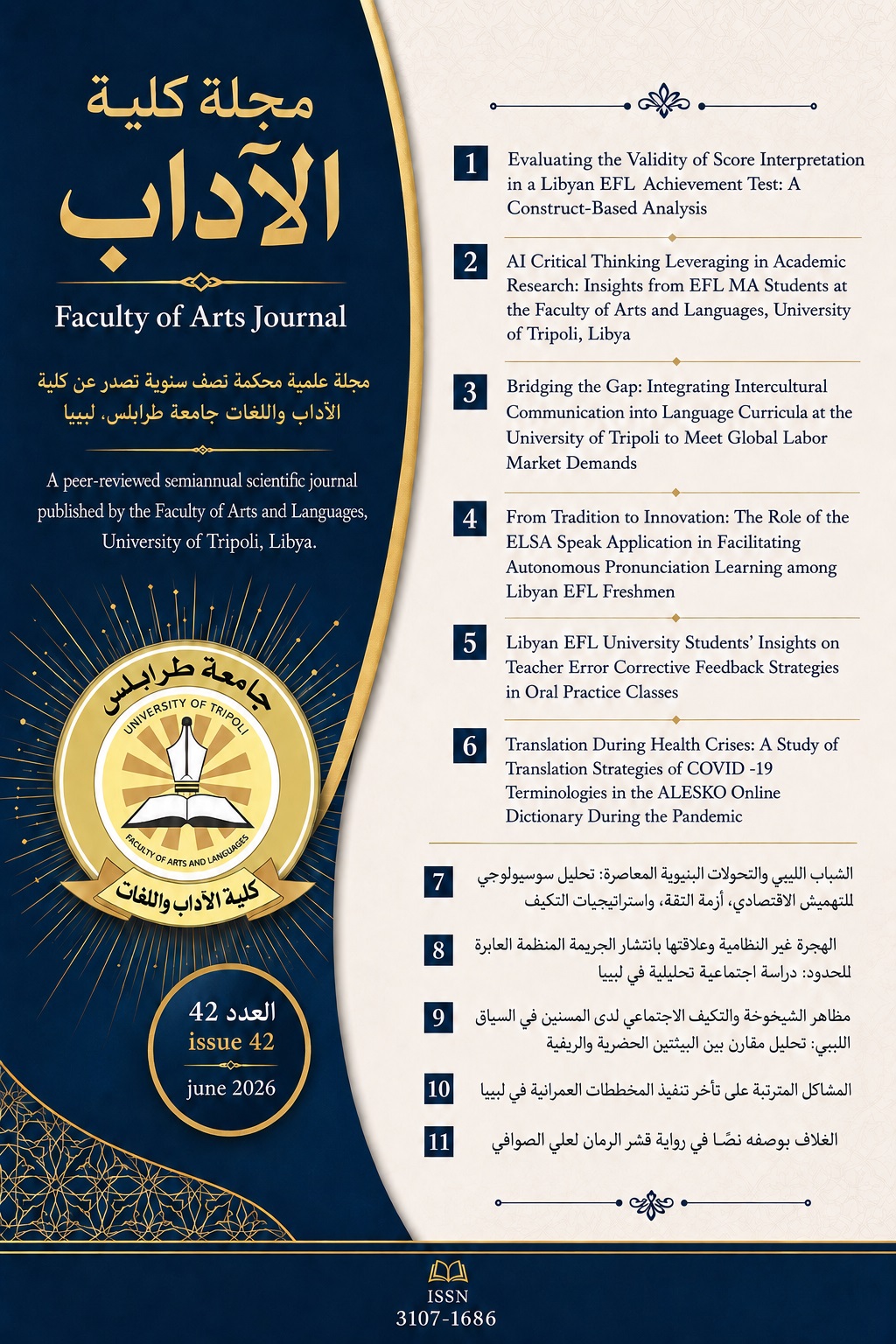
From Tradition to Innovation: The Role of the ELSA Speak Application in Facilitating Autonomous Pronunciation Learning among Libyan EFL Freshmen
الكلمات المفتاحية:
ELSA Speak, autonomous pronunciation learning, Self-Determination Theory (SDT), Skill Acquisition Theory (SAT), Libyan EFL learnersالملخص
This study investigated whether the free version of the ELSA Speak app facilitates autonomous learning and enhances pronunciation features among Libyan freshman English majors. A quantitative quasi-experimental research design, with a non-equivalent pre-test/post-test control group model was employed over a 12-week intervention. The participants were 30 freshmen who were divided equally into an experimental group and a control group based on a proficiency test. The findings revealed that the app successfully facilitated perceived autonomy (p = .002). However, no statistically significant improvement was found in pronunciation skills (p = .727). The study recommends integrating a blended approach of AI technology and teacher guidance to overcome persistent pronunciation errors